SpinLab XR: Rotor Balancing in Virtual Reality
A virtual engineering lab for learning how to measure vibration and balance a spinning rotor.
An off-center mass can make a spinning assembly shake. Correcting it takes more than adding a weight: you need to measure the vibration, understand its timing, and determine where a correction will help. I built SpinLab XR to make that process something you can explore with your hands.
The app runs directly on Meta Quest 2. Using the Touch controllers, you load a rotor, lower the guard, turn a probe micrometer, and adjust correction mass and angle. A monitor beside the bench displays captured vibration signals and how the response changes with rotational speed.
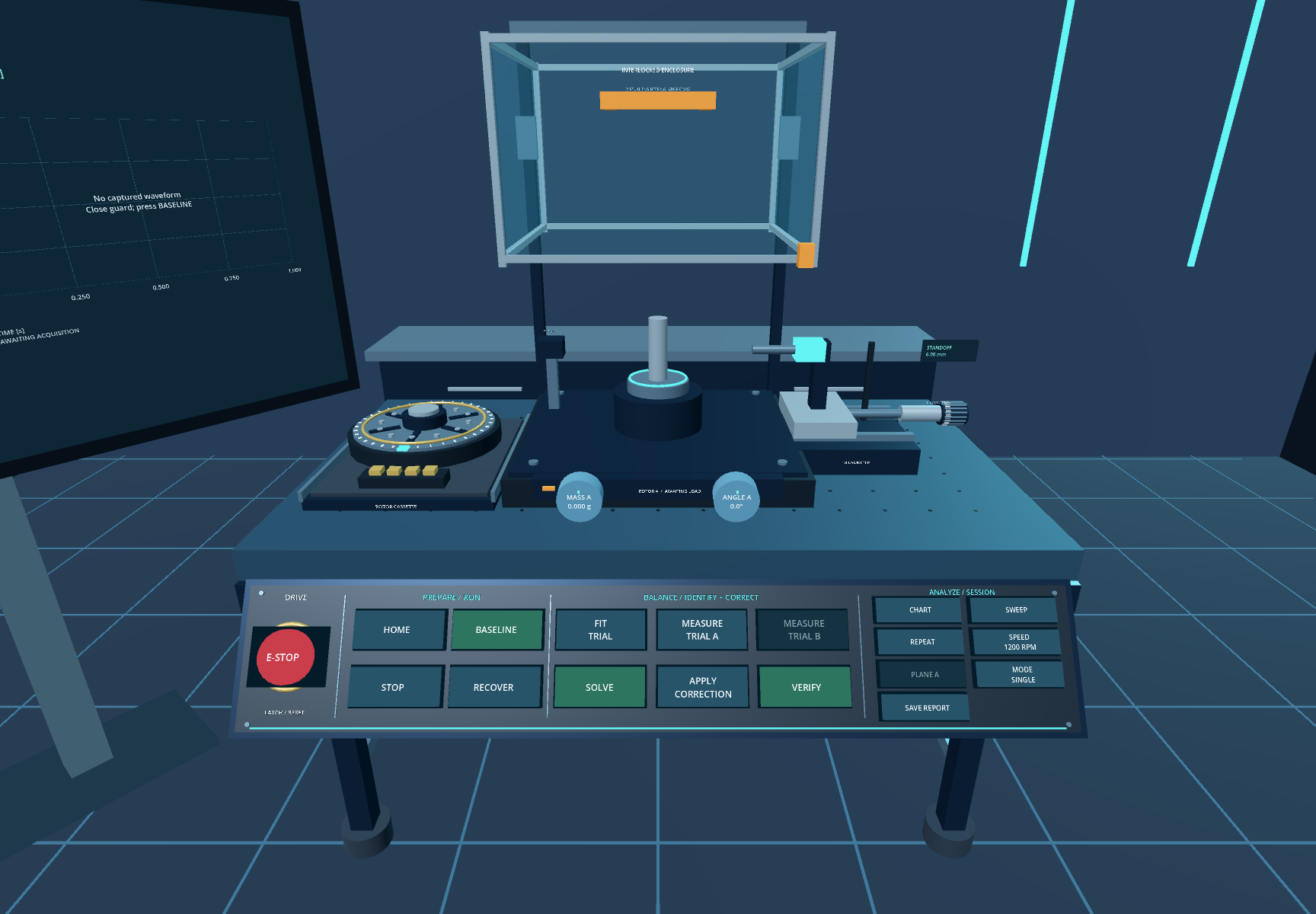
A 38-step narrated course starts with the basics and introduces each concept when you need it. Small prompts appear beside the next control; completing the task advances the lesson immediately. You establish a baseline, measure the effect of known trial masses in two correction planes, calculate a correction, and take a fresh measurement to check the result. Stopping, fault recovery, repeatability, and saving a test report are part of the exercise, too.
The balancing solver treats calibration as an experiment. A baseline and independent known trial masses establish how each correction plane changes vibration at both sensors. Using amplitude and phase, a 2×2 complex influence matrix yields a correction mass and angle for each plane. The code rejects weak or nearly singular calibration data and requires fresh measurements after speed or probe changes.
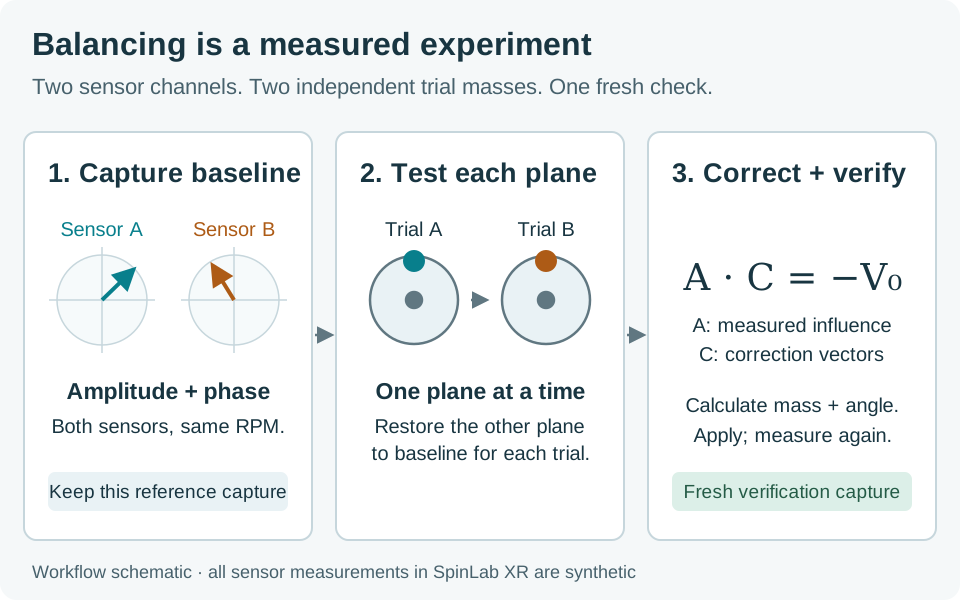
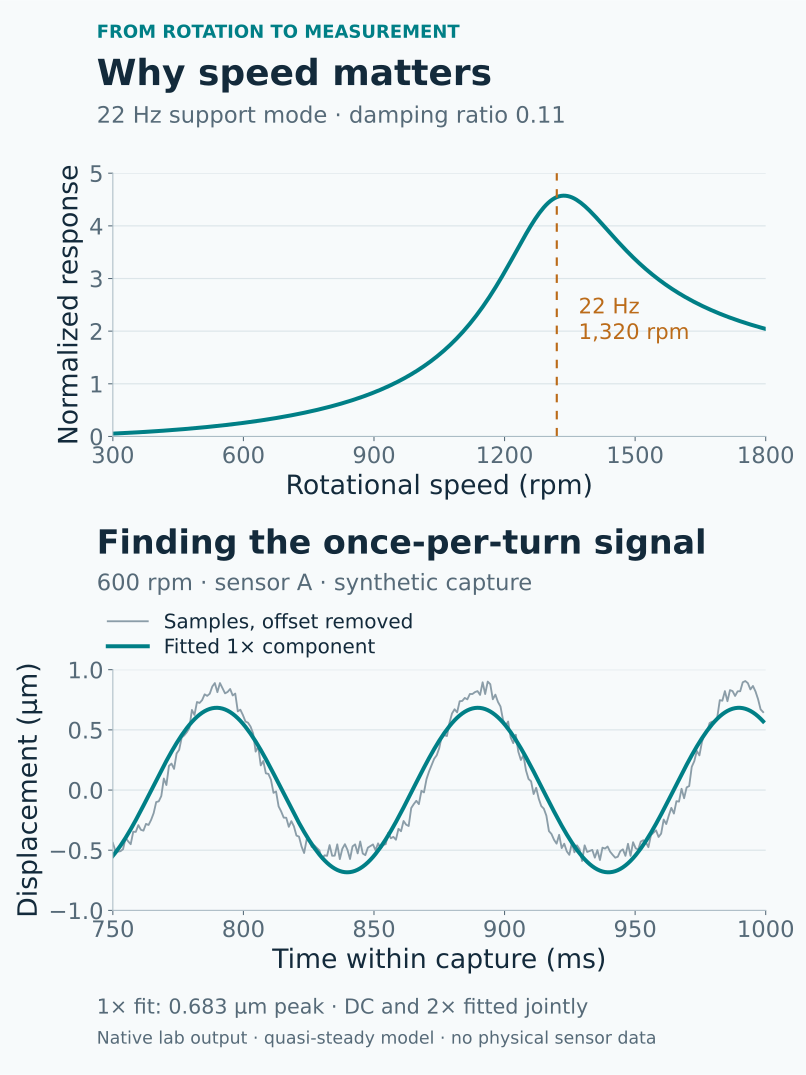
The measurement pipeline supplies those records from a reduced physics model. Unbalance forcing grows with speed squared; a damped support response adds resonance and phase shifts. Simulated captures include sensor offsets, a twice-per-revolution harmonic, and noise. A tachometer-referenced least-squares fit estimates the once-per-revolution vibration while accounting for the offset and second harmonic. Verification then checks the installed correction with a new capture.
Built with Godot and OpenXR and tested on Quest 2, SpinLab XR combines mechanical interaction, signal analysis, and guided instruction in one offline lab. It offers a way to rehearse a complex procedure before using physical equipment.
Explore the project on GitHub or download the Quest APK and installation guide.