FixtureForge: Checking Tool Access in CAD
Inspect whether a simplified tool can follow a declared path through a fixture or small assembly.
A part can fit inside a fixture while leaving no route for a screwdriver or connector to reach it. FixtureForge checks that narrower assembly question: can a simplified tool follow a specified straight path without intersecting the parts around it?
I see this as a small, inspectable integration of existing CAD tools. CadQuery supplies the geometric operations; FixtureForge adds an input contract, repeatable checks, and reports identifying the obstructing part. Its comparison with CadQuery, build123d, and CADCLAW illustrates why checking only the starting and ending positions can miss an obstacle in between.
How it is used
The intended user is an engineer checking access in a fixture or small assembly. After following the installation and demo instructions, the workflow is:
- Supply each part as a single-solid STEP file in millimetres.
- Define a box or cylinder representing the tool, its starting and ending positions, and the parts present at that assembly stage in the JSON access contract.
- Run the inspection and open the local HTML report. The check considers the volume occupied along the whole path.
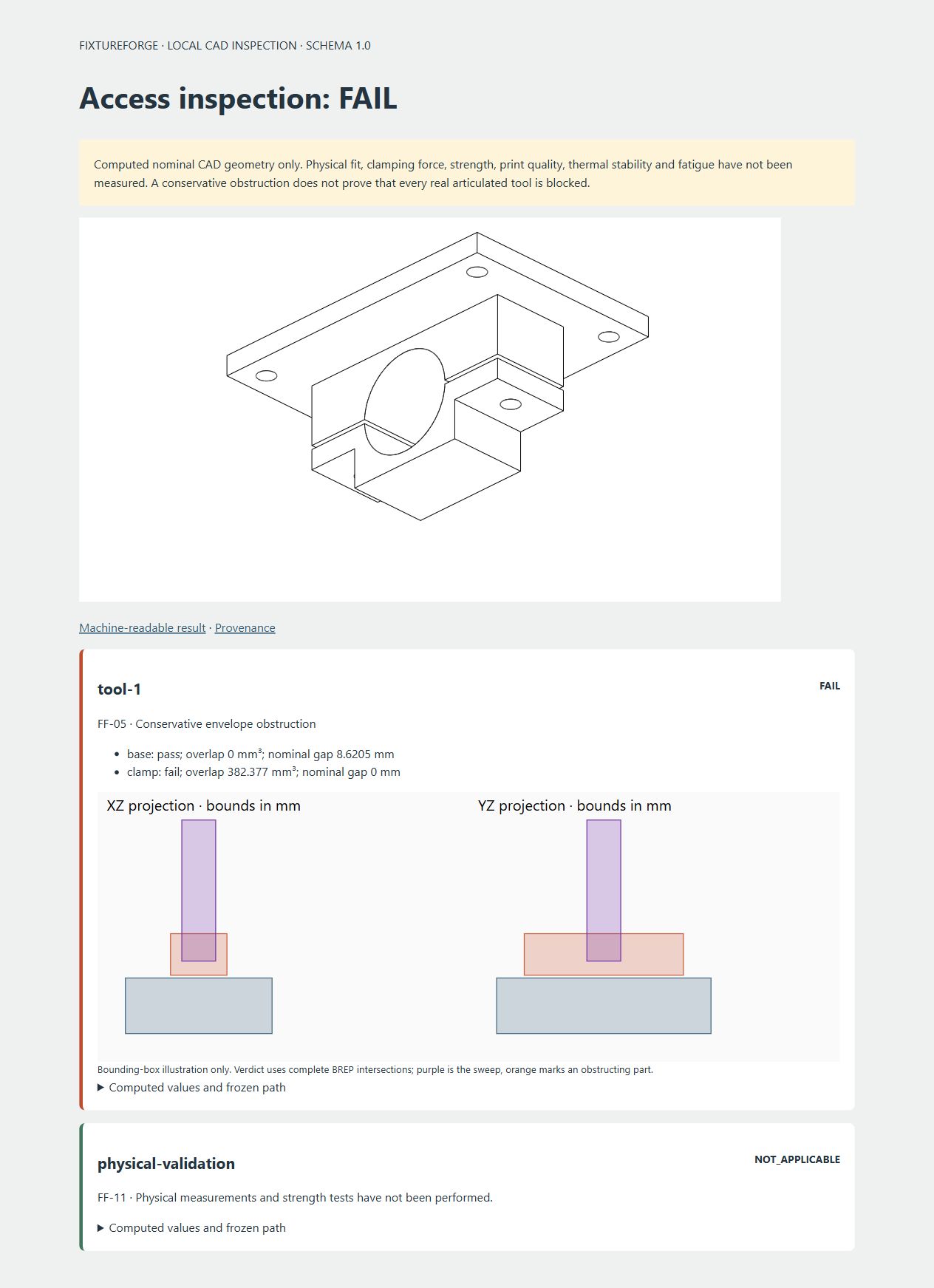
The supplied sensor-clamp demonstration deliberately routes a tool through the upper clamp. Its report shows approximately 382.377 mm³ of overlap. The demo also includes a corrected path, making it possible to inspect both outcomes.
Validation and limits
The publication audit passed 61 tests; four inspect retained campaign evidence rather than rerunning those campaigns. The audit evidence records the checks. The software is runnable, with setup verified on Windows and Python 3.12.
I would use it to investigate a declared access path, not approve an assembly. It supports straight translations and conservative envelopes, which can over-report collisions. It does not plan rotating motions or establish clamping force or material strength. The clamp has not been physically validated, and usefulness to an independent practitioner remains untested.